Project: SolarFlux AI
Solar Energy Prediction and Planning Model by Soham Gupta
- SolarFlux AI Web App https://solarfluxai.streamlit.app/#enter-features
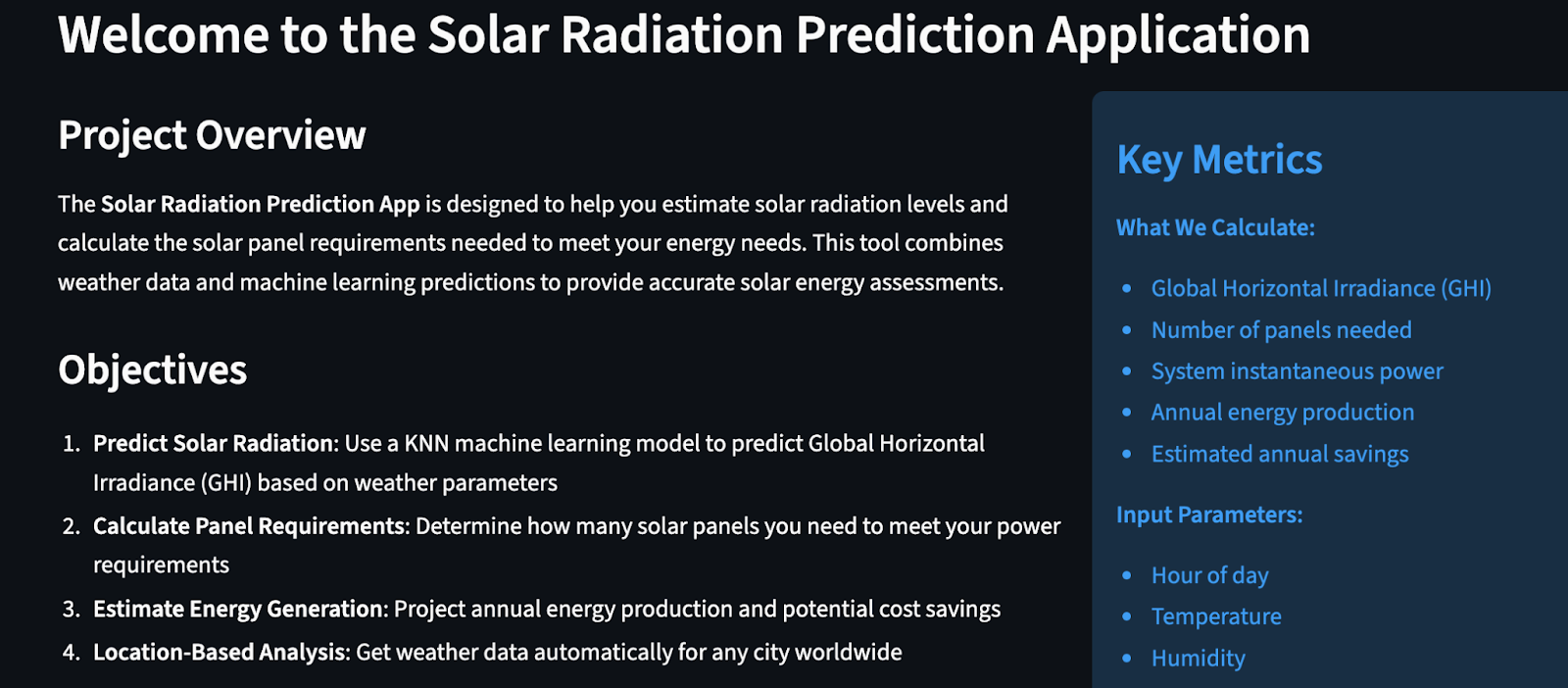
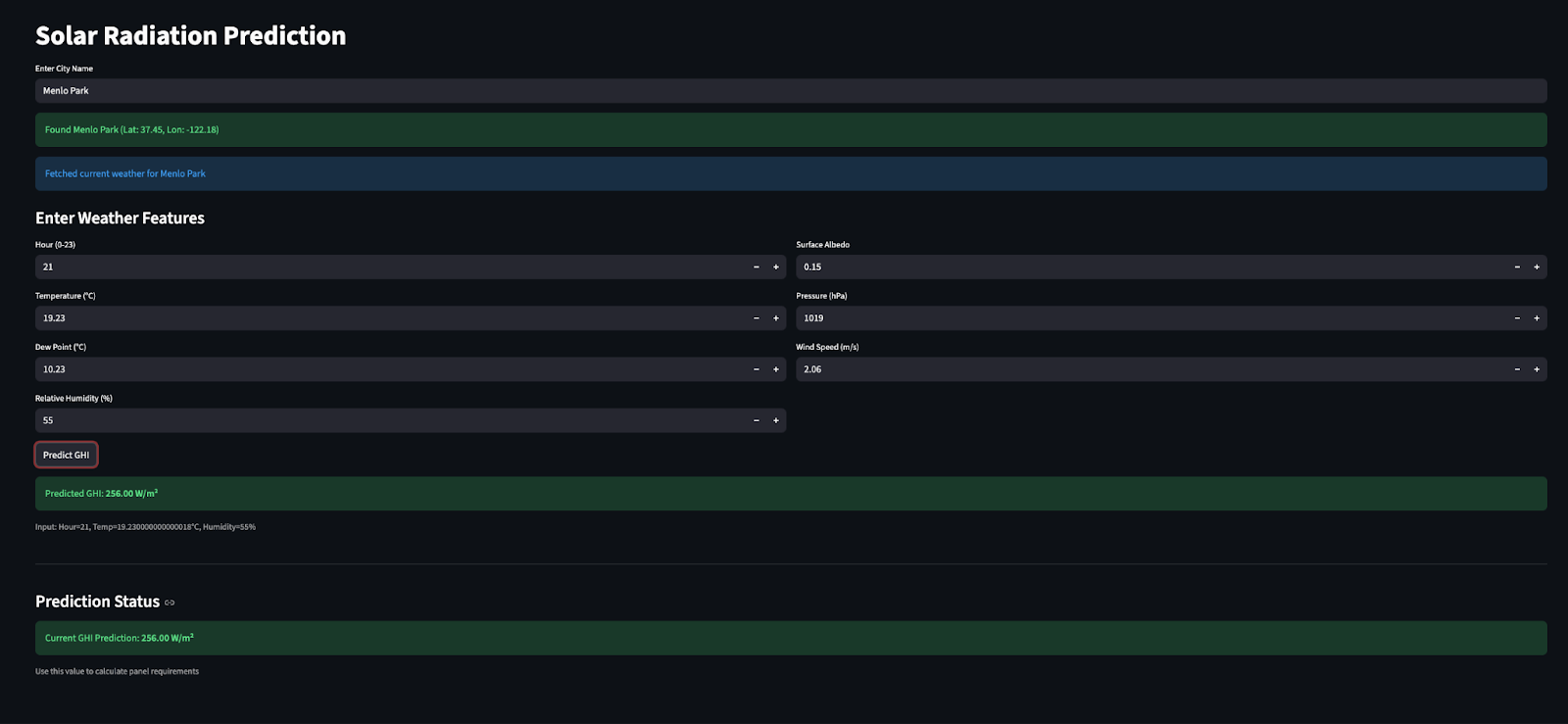
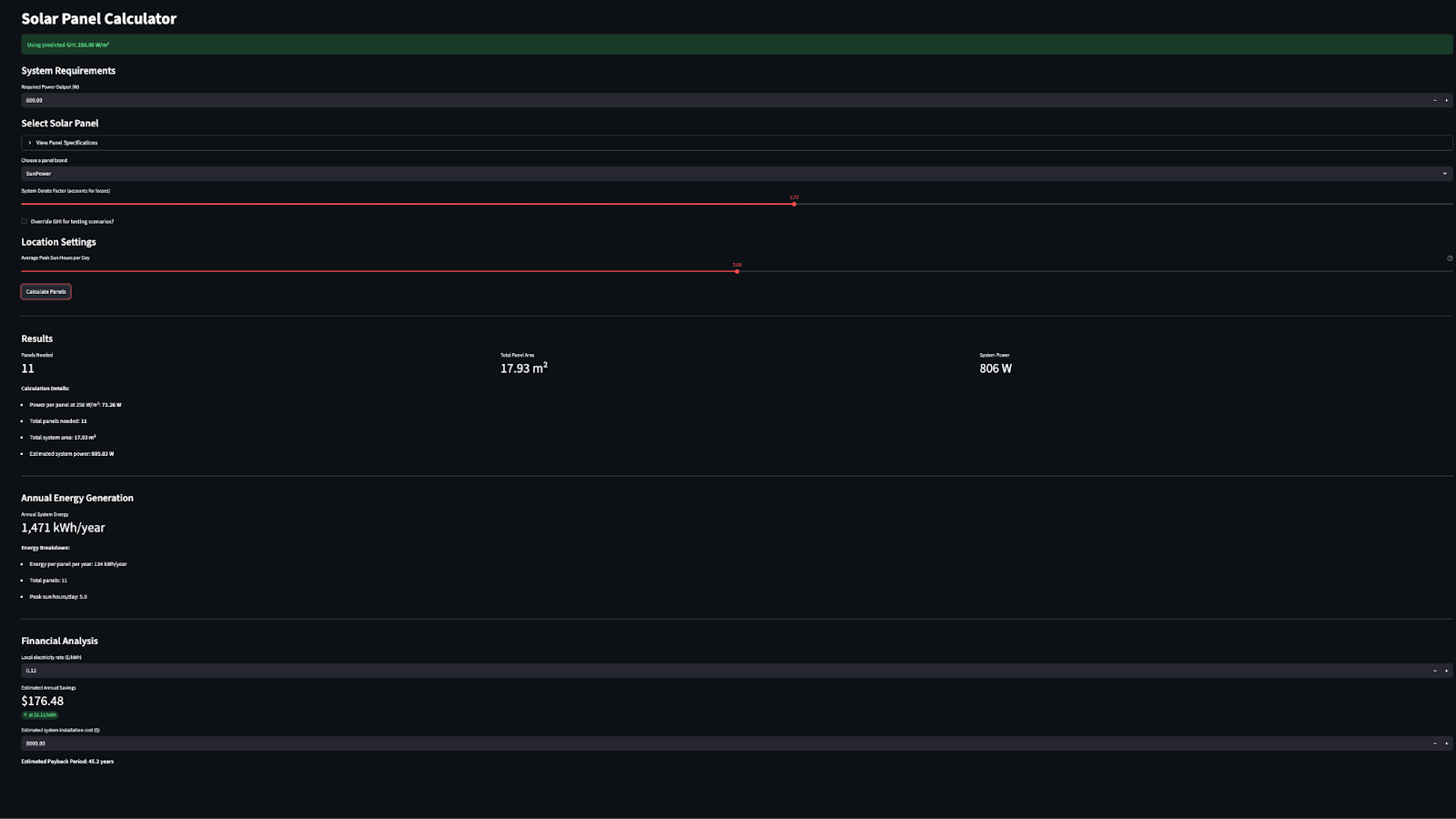
- (Based on the inputs, output would be the predicted GHI and also the number of solar panels needed in a certain city which would depend on the amount of wattage needed and solar panel brand)
- Video: https://www.youtube.com/watch?v=rz7zgf7N1Eo
- Deck: Soham Gupta-SolarFluxAI
SolarFlux AI Web App Link: https://solarfluxai.streamlit.app/#enter-features
My Project Goal is:
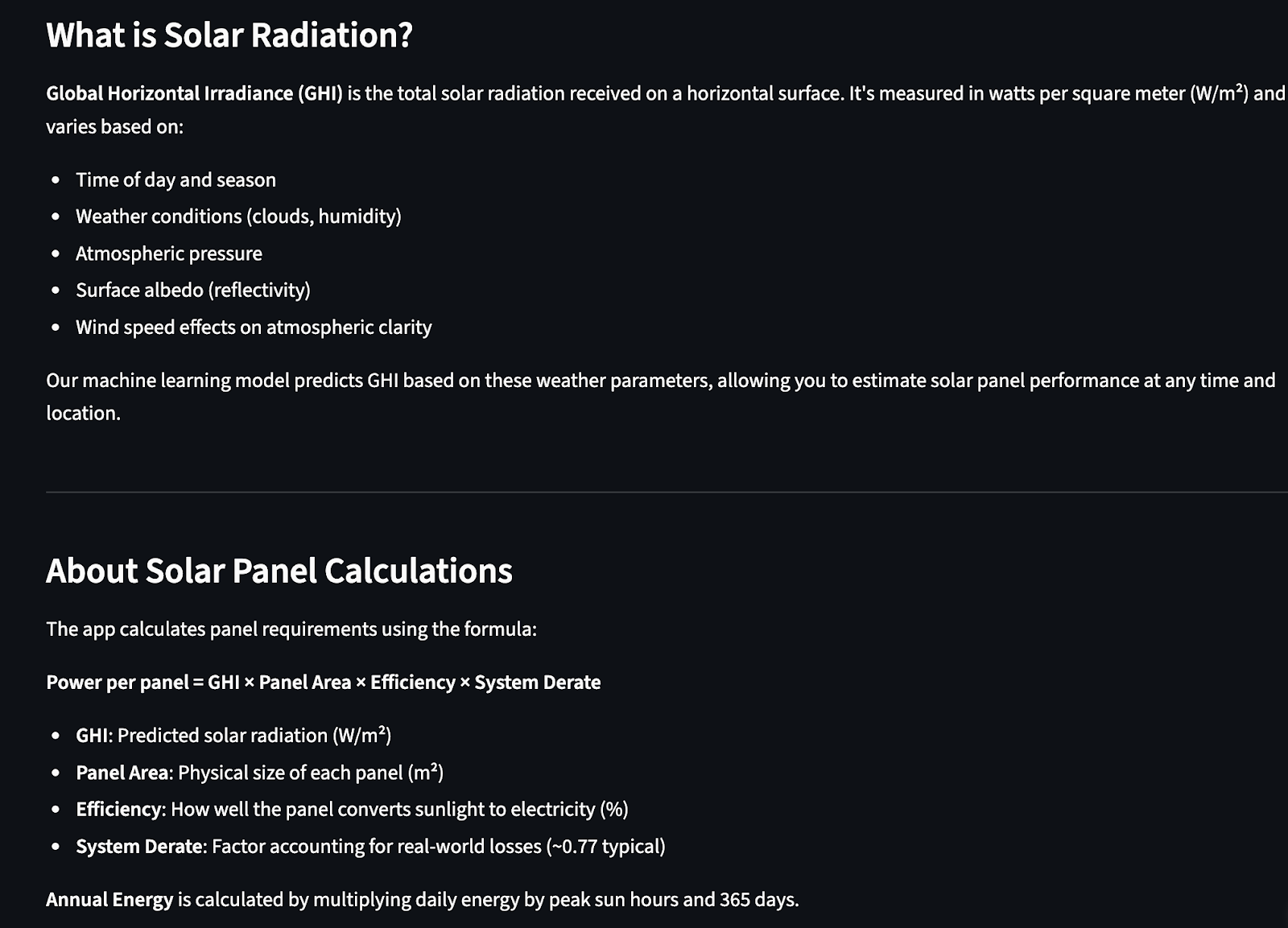
The goal of this project is to design an artificial intelligence system that accurately predicts solar energy output (Global Horizontal Irradiance, GHI) for a city and helps homeowners estimate the number of solar panels needed, making solar energy adoption easier and less risky.
My Project Design Criteria are the following:
1. The AI model must achieve an R² value of at least 0.85.
2. The RMSE must be less than 110 W/m².
3. The system must generate predictions in under 3 seconds.
4. The app must output predicted GHI and number of solar panels required.
5. All calculations must use SI units.
My Project Constraints are the following:
1. Use only free and public datasets.
2. Must run in a browser-based environment.
3. Limited to student-level computing hardware.
4. Timeline limited to science fair season.
5. Software-only project (no hardware).
My Project Design:
This is a software-based engineering design using Python, Scikit-learn, Pandas, NumPy, Streamlit, and Matplotlib. The system uses a KNN regression model to predict GHI from weather parameters, then calculates the number of solar panels needed. A Streamlit web interface displays results.
I test and analyze my prototypes using the following methods:
The dataset is split into training and testing sets. Performance is measured using RMSE and R². The web app is tested with multiple city inputs for accuracy and stability. This is a computer-based project with no human or physical safety risks.
Bibliography:
1. NASA POWER Dataset, https://power.larc.nasa.gov, accessed Jan 2026.
2. U.S. Department of Energy, https://energy.gov, accessed Jan 2026.
3. Géron, A., 2019, Hands-On Machine Learning, O’Reilly.
4. Scikit-learn Documentation, https://scikit-learn.org.
5. Global Solar Atlas, https://globalsolaratlas.info.
SolarFlux AI Web Application
SolarFlux AI Web App https://solarfluxai.streamlit.app/#enter-features
Based on the inputs output would be the predicted GHI and also number of solar panels needed in a certain city which would depend on the amount of wattage needed and solar panel brand.


